
why is OEE data wrong again (blueprint for you)
Most manufacturers and asset heavy companies re drowning in disconnected data, not short on technology. Learn the 4-layer blueprint to build data strategy that actually drives ROI.

The Lie of “Digital Transformation”
Let’s be blunt.
Most manufacturers are told they need “digital transformation.”
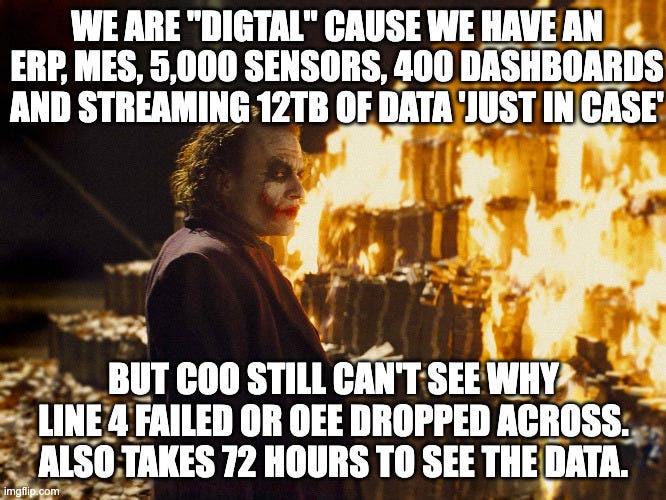
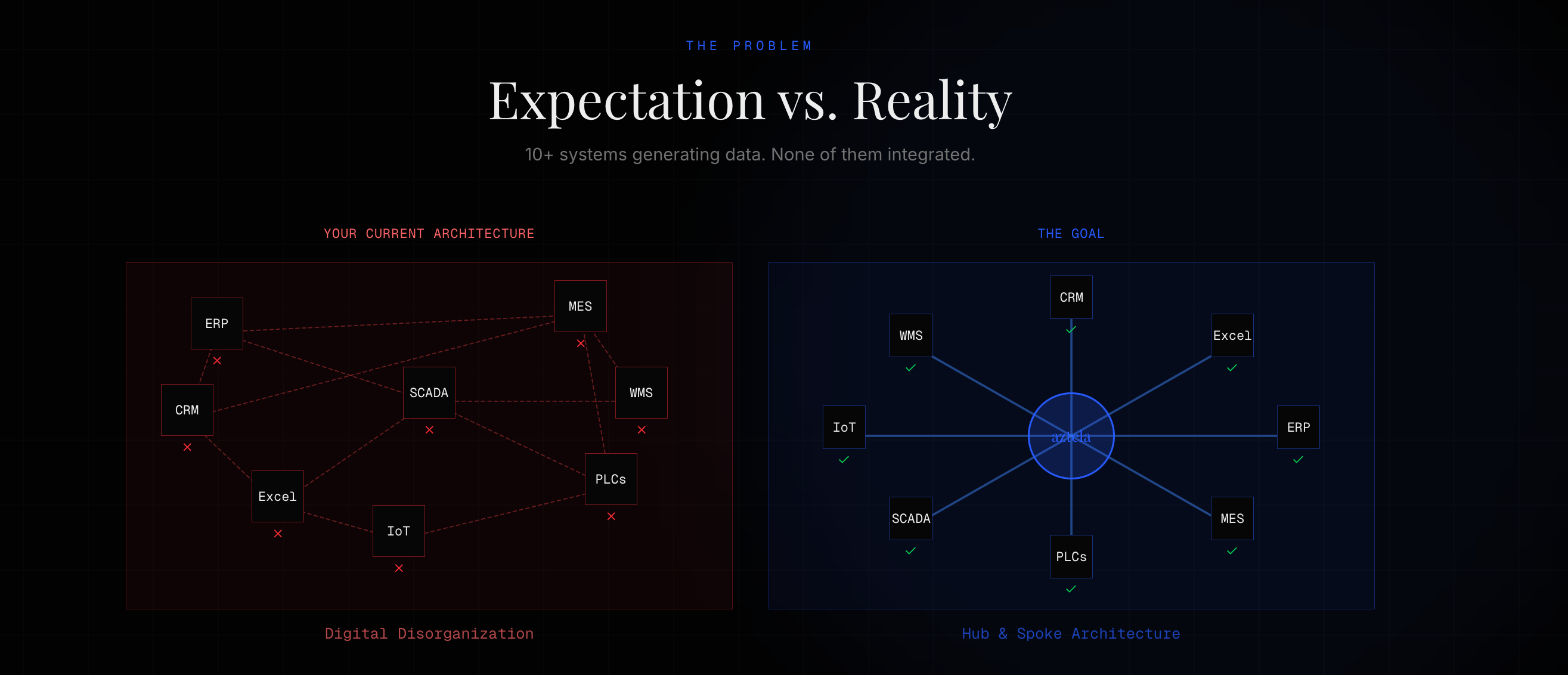
But what they really have is digital disorganization 20 years of systems, sensors, and spreadsheets that don’t talk to each other.
The result?
10+ systems generating data.
None of them integrated.
Dashboards no one trusts.
And every new initiative dying in “pilot purgatory.”
Here’s the truth: you don’t need more tools. You need a data strategy.
Your Run on Tribal Knowledge, Not Trusted Data
If you’re a mid-market manufacturer, you’ve likely invested in automation, MES, ERP, and maybe even some IoT projects.
But ask your operations lead three simple questions:
“Can we see real-time OEE across lines?”
“Do we know why downtime is happening?”
“Can we trace quality issues back to root cause, supplier to shift to machine?”
In most org, the answer is the same:
“Not really. We think we can, but it takes weeks.”
That gap is where profits vanish, and where your competitors are quietly winning.
You don’t fix that with another dashboard.
You fix it with a data foundation, an asset-heavy data strategy that turns your disconnected systems into an intelligence engine
What an Manufacture Data Strategy Actually Is (and Isn’t)
This is for asset-heavy companies. From manufacturing, supply chain, logistics it applies across.
Let’s kill the confusion.
An industrial data strategy isn’t a cloud migration plan.
It’s not a list of tools.
It’s not a “data lake” project.
It’s a business-first operating model for how your organization collects, connects, governs, and uses data to make faster, smarter, more profitable decisions.
In manufacturing terms:
It’s your digital backbone, the system that turns machine data into executive decisions.
The 4-Layer Blueprint (Ingest → Store → Contextualize → Act)
This is the exact framework AWS, Rolls-Royce, and leading mid-market manufacturers use, and it scales down perfectly for companies with lean teams.
1. Ingest — Capture What Matters, Not Everything
Most manufacturers try to boil the ocean.
They connect every ERP, finance tools, PLC, tag, and sensor.
Result? A data swamp that no one uses.
The goal of the ingest layer isn’t “collect everything.”
It’s collect the right data at the right granularity for your use cases.
Ask yourself:
What decisions do we want to make in real time (e.g., downtime alerts)?
What decisions can be batch or historical (e.g., maintenance optimization)?
What challenges, problems we want to solve?
Your ingest layer should:
Connect to your WMS, PLCs, MES, ERP, quality, and maintenance systems
Standardize protocols (OPC-UA, MQTT, Modbus)
Filter and transform data at the edge before it hits the cloud
Tag data by asset, line, and process at the source
This is where most data projects die, they bring in everything, label nothing, and drown.
Smart manufacturers design at the edge.
2. Store - Build a Data Lake, Not a Data Swamp
Data storage isn’t about capacity. It’s about structure.
You’ll deal with three types of data:
Time-series (IoT, sensors, PLC tags)
Structured (ERP, MES, quality systems)
Unstructured (PDFs, images, reports, logs)
A good storage layer uses the Bronze–Silver–Gold model:
This separation prevents chaos.
Bronze is your raw truth. Silver is your analytic foundation. Gold is what execs trust.
In short: you can’t get clean dashboards from dirty data architecture.
3. Contextualize - Turn Data into Meaning
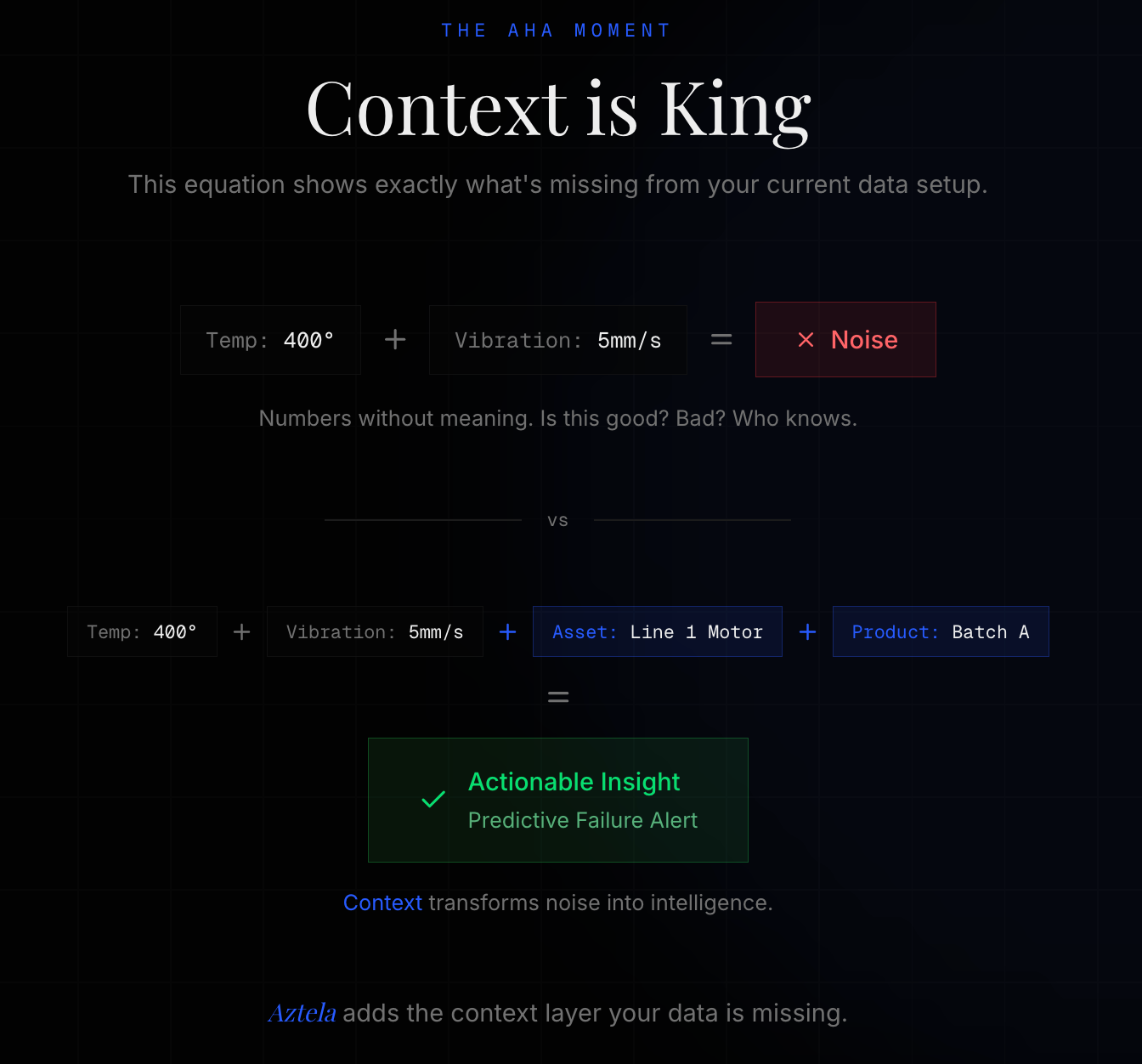
Contextualization is the bridge between “data” and “decision.”
Without it, you’re just moving CSVs around.
Every manufacturer already has data. The problem is no one knows what it means across systems.
Contextualization gives your data meaning - by linking machine, product, operator, supplier, and process in one digital model.
Two ways to do this:
Unified Namespace (UNS): A hierarchical structure that publishes and subscribes data across systems using standard naming (e.g., MQTT).
Think of it as your “factory data dictionary.”
It’s not a database. It’s how you make data readable and reusable.
Knowledge Graph: A graph database that links quality, process, and supply chain data for traceability.
Enables root cause analysis and digital twins.
Turns “data lookup” into “data intelligence.”
Context is what makes “predictive” possible.
No context → no AI.
4. Act - Turn Data into Action, Not Reports
Most manufacturers stop at dashboards. Smart ones close the loop.
The “Act” layer is where your strategy creates value, when data triggers business actions automatically.
Example:
Manufacturing: IoT detects abnormal vibration → ML model predicts failure → automatically creates SAP work order → maintenance team fixes before downtime.
Logistics: Idle time exceeds threshold → sends automatic fuel optimization recommendations to route planner.
and many other not need to be ops orianted all the time.
That’s the holy grail of operational data flow, no PowerPoint needed.
It’s also where real-time decisions finally align IT, OT, and business:
Operations sees current performance
Maintenance sees upcoming risks
Executives see impact on output and cost
You don’t get that with more BI tools. You get it with architecture discipline.
How to Build Your Industrial Data Strategy (Weeks Not Months )
Most execs think “data strategy” means hiring consultants for 18 months.
It doesn’t.
It means aligning your business goals with your data maturity, step by step.
Here’s the roadmap that works:
Step 1: Define the Business Problem, Not the Tech Stack
Pick one measurable pain point:
Unplanned downtime
Route or Fleet optimization
OPEX reduction
Decrese in COD
Poor OEE visibility
Quality traceability
Late delivery due to data delays
Then define how better data flow solves it.
Every architecture starts with a use case, not a tool.
Step 2: Map Your Data Landscape
List every source system: MES, ERP, quality, maintenance, PLCs, spreadsheets.
Map how data flows (or doesn’t).
Identify duplicates, manual work, or blind spots.
You’ll find 80% of your pain isn’t missing tools, it’s missing connections.
Step 3: Pick a Scalable Foundation
The best architectures today are hybrid:
Edge for low-latency control and safety.
Cloud for scale, machine learning, and collaboration.
Step 4: Standardize Early, Govern Lightly
You don’t need a 50-page governance deck.
You need naming conventions, unit consistency, and clear data ownership.
Example:
Temperature → always Celsius.
Machine state → always RUNNING/STOPPED, not “On/Idle/Active.”
Set it once. Enforce it everywhere.
That’s 80% of data quality solved.
Step 5: Start Small, Scale Fast
Start with one site, one use case, one measurable ROI.
For example:
Connect three production lines → stream OEE → visualize downtime → feed alerts to maintenance.
Keep it simple.
When it works, scale horizontally (more lines) or vertically (more systems).
That’s how mid-market manufacturers modernize, incrementally, not ideologically.
The Payoff: What Happens When You Get It Right
When mid-market manufacturers and asset heavy orgs implement an data strategy correctly, three things happen fast:
Operational Visibility
You finally know what’s happening on every line, in near real time.
No more waiting until Friday for Excel rollups.Data Trust
Maintenance, quality, and operations teams stop arguing about “whose data is right.”
Everyone’s pulling from the same contextualized truth.AI Readiness (the Right Way)
You can actually pilot predictive maintenance, quality analytics, or digital twins and get ROI because your data is trustworthy.
The Hard Truth
If your analytics or AI initiatives are stalling, it’s not because your people “don’t get data.”
It’s because your organization doesn’t have a data foundation.
Most manufacturers or asset heavy orgs try to skip straight to AI or machine learning, but that’s like installing a turbocharger on an engine that leaks oil.
You don’t need more tools.
You need better plumbing.
Industrial data strategy isn’t about technology. It’s about control.
Control over your processes, your costs, and your decision speed.
The Blunt Bottom Line
You don’t need more software.
You need a blueprint.
A factory without a data strategy is like a production line without a quality system — you can still make parts, but not profitably, not predictably, and not at scale.
The next generation of manufacturing leaders aren’t the ones with the best machines.
They’re the ones who know how to make their data work as hard as their people.
Industrial data strategy is your blueprint for that.
Get the foundation right and everything else accelerates.
If you are COO, Supply Chain, Data, Tech or IT Leader in manufacturing, logistics, supply-chain and asset-heavy industries facing data chaos like this…
📩 Reply to this email or book a Free Data Strategy Session with our team to see how you can build scalable AI-ready data foundation, setup data department for success and leverage your proprietary data to gain edge in the market in 2026.