
your modern data infrastructure is sh*t
Modern defense organizations have already solved the problem your company is still struggling with rigid, fragmented data systems. Learn how flexible data platforms transform organizations.

Your data stack looks immaculate. On paper, you’ve built the perfect architecture.
In reality, it’s become a liability.
Every change requires coordination across six systems.
Pipeline updates break dashboards you didn’t even know existed.
Your engineers are buried under maintenance.
And the business still can’t get a trusted number fast.
You didn’t build a scalable data infrastructure.
You built a fragile ecosystem of dependencies that now owns you.
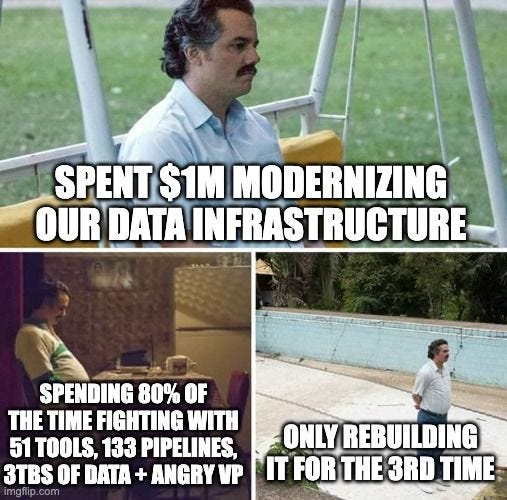
What Defense Learned That Your Business Still Ignores
Defense learned it the hard way.
Business still hasn’t.
While most enterprises are debating which tool to buy next, the world’s most complex organization the defense sector has already proven that the answer isn’t “another platform”
It’s a flexible agile data foundation that can pivot at mission speed.
Modern militaries don’t have the luxury of 6-month data roadmaps.
When threats change by the hour, your systems can’t take six weeks to refresh a dashboard.
Yet that’s exactly what most companies still accept as normal.
You don’t need defense-grade hardware.
You need their discipline in how they built flexible, unified data infrastructure that move at the pace of the business not vice versa.
From Patchwork Systems to Mission Agility
In the early 2000s, defense data looked exactly like most mid-market companies today.
A patchwork quilt of legacy systems, disconnected platforms, and manual Excel cleanups that only one engineer understood.
Operational data in one format, Finance in another.
Intelligence reports trapped in PDFs.
Maintenance logs stored in flat files.
Commanders making real-time decisions on week-old summaries.
This applies pretty much to everyone as we seen it all across from manufacturing, industrial, healthcare, finance and others.
That chaos didn’t just slow reporting.
It slowed missions.
When cyber and autonomous operations arrived, that model broke.
You can’t run AI-assisted targeting or multi-domain command with 30 incompatible systems and 50 data schemas.
So defense data teams did something most companies refuse to: they stopped “adding tools” and rebuilt their foundation.
They moved from many disconnected systems → to flexible, rationalized data platforms that were:
Centralized enough for trust and control
Modular enough to integrate new technologies fast like lego.
Governed enough to enable secure sharing
Flexible enough to adapt to any mission, domain, or partner
In short: They treated data like a weapon system, like a moat not a reporting function.

The Lesson Businesses Still Ignore
Mid-market and enterprise companies especially those with lean data teams are building fragile data foundations.
A manufacturing company (over 500-FTE) came to us with a familiar complaint:
“We have everything, but nothing works together.”
Their architecture looked like a vendor expo at Gartner Event:
Azure Synapse for storage
Databricks for transformation
Airflow DAGs for orchestration that would make someone sick maintaining it.
Gazzilion custom pipelines that nobody have clue what they do.
Real time pipelines (IoT)
12 BI tools that nobody knows what happening.
dbt for modeling
Five internal Python tools “to fill the gaps”
12 BI tools
dozens of one-off connectors and APIs nobody owns
The result?
$1.6M annual cloud bill
19-step pipeline
12-minute average query time
5 separate definitions of “Revenue”
No trust, adoption or ROI.
They didn’t have a data stack.
They had a data zoo.
The problem wasn’t capability, it was complexity.
They built over-engineered system that was modern but acted as legacy.
Every new initiative adds another dependency.
Every business change creates another integration project.
Every “quick win” introduces long-term rigidity.
Meanwhile, your competitor and yes, your own analysts are already treating data platforms as adaptive ecosystems.
Why Your Data Infrastructure Fails
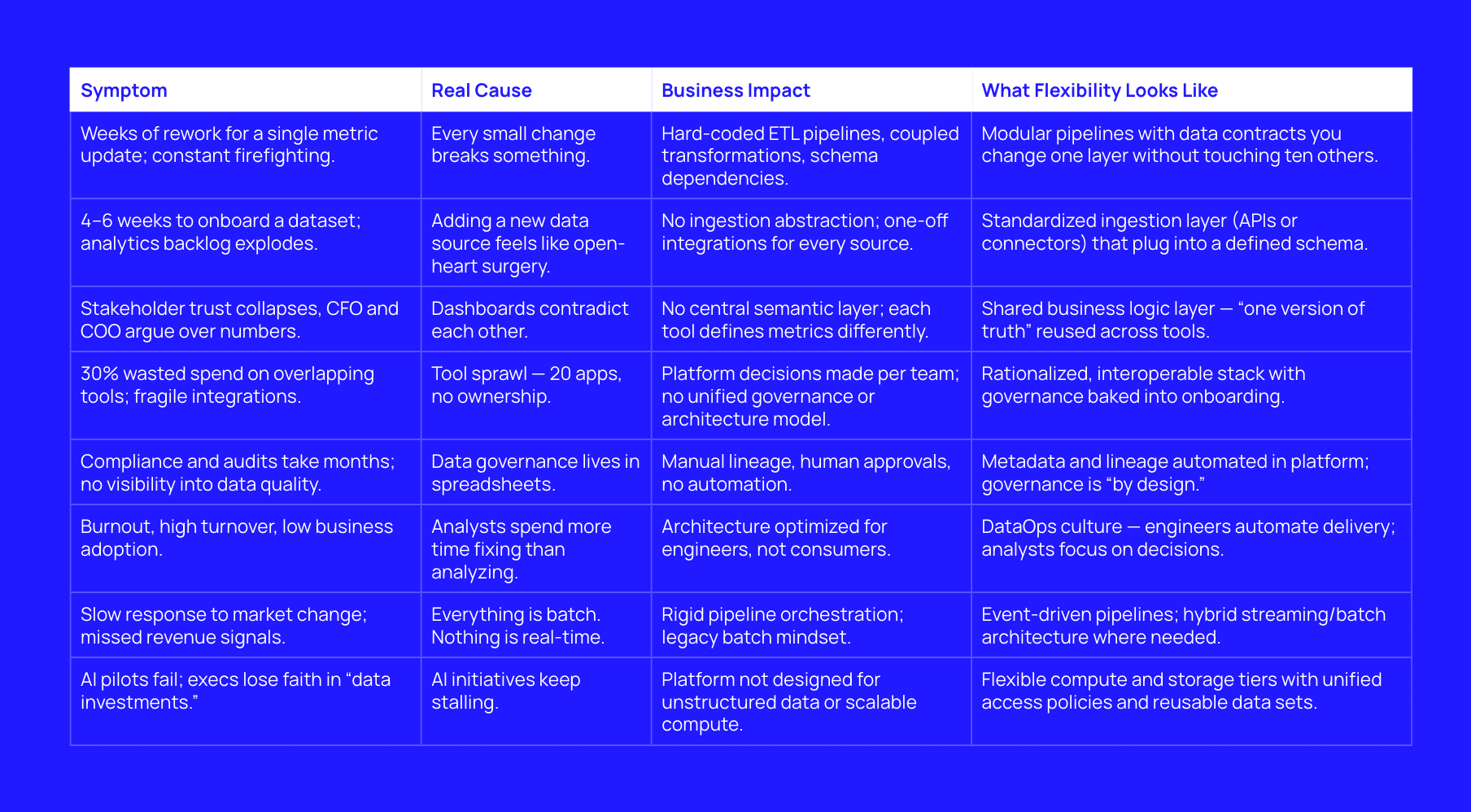
The Playbook: How to Build Flexibility Like Defense
1. Rationalize Before You Modernize
Defense and other orgs didn’t start by buying shiny new platforms or tools.
Most stacks are designed by engineers.
They should be designed by outcomes.
They started by counting what they already had and killing what didn’t add value.
Do this:
Inventory every system that stores, processes, or reports data.
Quantify ownership, purpose, and business usage.
Eliminate redundancy (every duplicate metric, schema, or ETL flow).
If a system doesn’t drive decisions or compliance retire it.
That’s your first win.
You gone notice that majority, parts you don’t need. When I say don’t need actually don’t need.
2. Unify Around a Single Platform Backbone
They built what they call Enterprise Data Platforms - rationalized environments that consolidate data governance, integration, and compute.
For your business, that means:
One warehouse or lakehouse (Snowflake, BigQuery, Databricks)
A consistent ingestion layer (Fivetran, Airbyte, dbt or custom pieplines)
Shared governance with the code (data catalog, access controls, lineage)
Standardized semantic layer or data models in the warehouse.
Adopt a 3-Layer Data Stack Model
Every mid-market and enterprise company needs only three essential layers to scale:
Storage/Compute Layer → Cloud data warehouse (Snowflake, BigQuery, Redshift).
Transformation Layer → SQL-based, version-controlled modeling (dbt).
Consumption Layer → One semantic layer
The flexibility doesn’t come from tools, it comes from standardization.
3. Make Data Architecture Modular by Design
Your systems must survive disruption.
Design architectures that can pivot instantly, modular pipelines, containerised workloads, isolated domains.
Your data architecture in should feel like building LEGOs .
Only by impact, modular, each use case support next one.
You don’t need FAANG-level infrastructure when you are at level 5.
You need to build a system that can evolve, and impact your bottom line.
That’s what “flexible” really means in practice:
Add or remove a data source without rewriting half your stack
Swap analytics tools without breaking lineage
Deploy new AI workloads on top without re-architecting
Ship new data products because foundation already done
Automatically update governance documentation,
Most commercial stacks fail this test.
They’re hardwired, not modular and every change is a rebuild.
That’s not flexibility; that’s friction.
4. Bake Governance Into the Foundation
Governance beats friction.
It’s the enabler of agility because nothing slows missions faster than untrusted data.
Their approach:
Data definitions codified in metadata, not PowerPoints
Permissions and access modeled into the platform layer
Auditability automated through lineage tracking
Your teams should never debate “whose number is right.”
If they are, your platform isn’t flexible it’s fragmented.
5. Embed Human Adaptability, Not Just System Agility
Don’t just rebuild systems, retraim people.
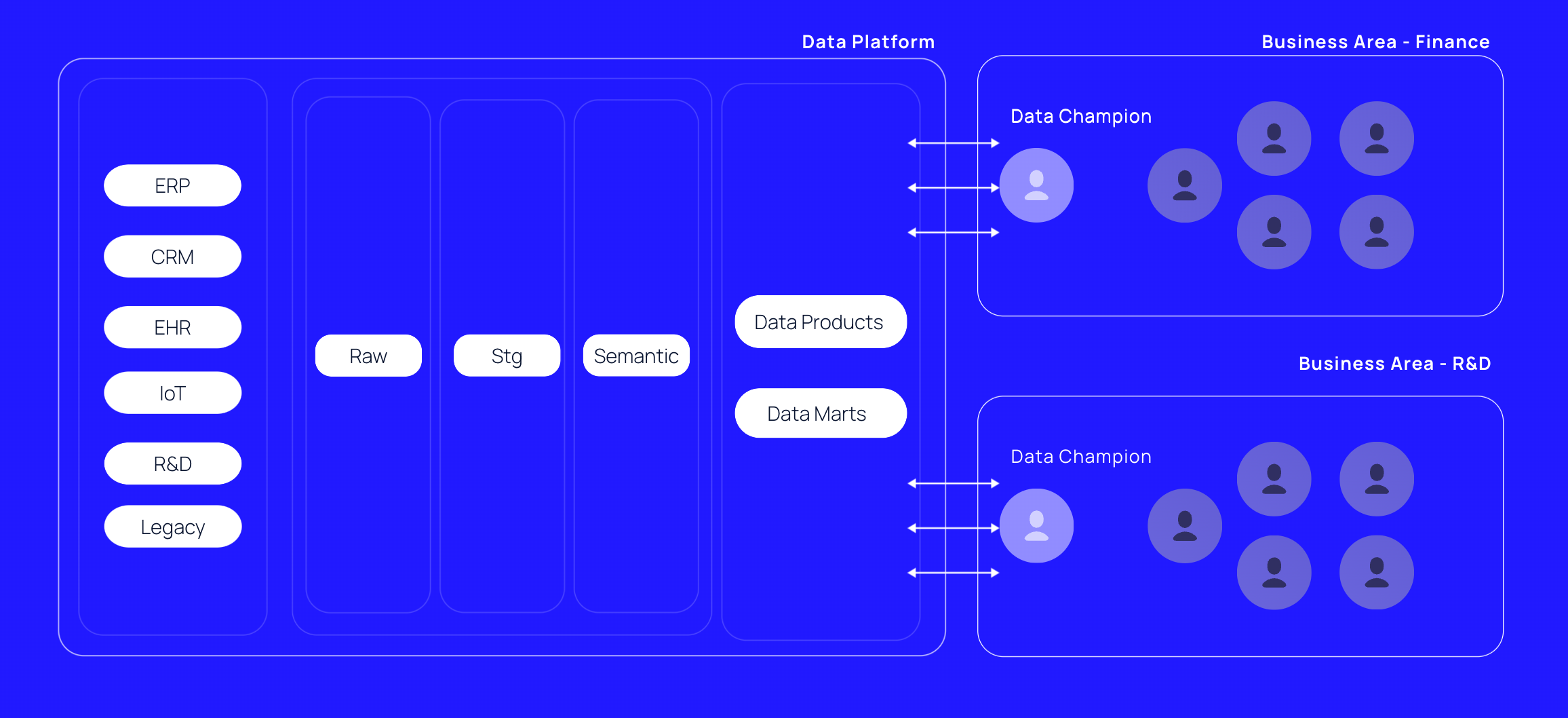
Move from engineering-first to establishing true self-service
Every analyst, VP, and Director could interpret, trust, and act on data.
That’s flexibility at the human layer.
True data enviroment where you centrelize everything, but federate products.
This way you gain agility, flexibility while remaining control.
If looking to learn how to implement this:
→ Download Full Self-Service Playbook Here
Your company can do the same:
Build data champions within departments
Gain feedback and iterate based on that.
Incentivize data quality ownership, not just consumption
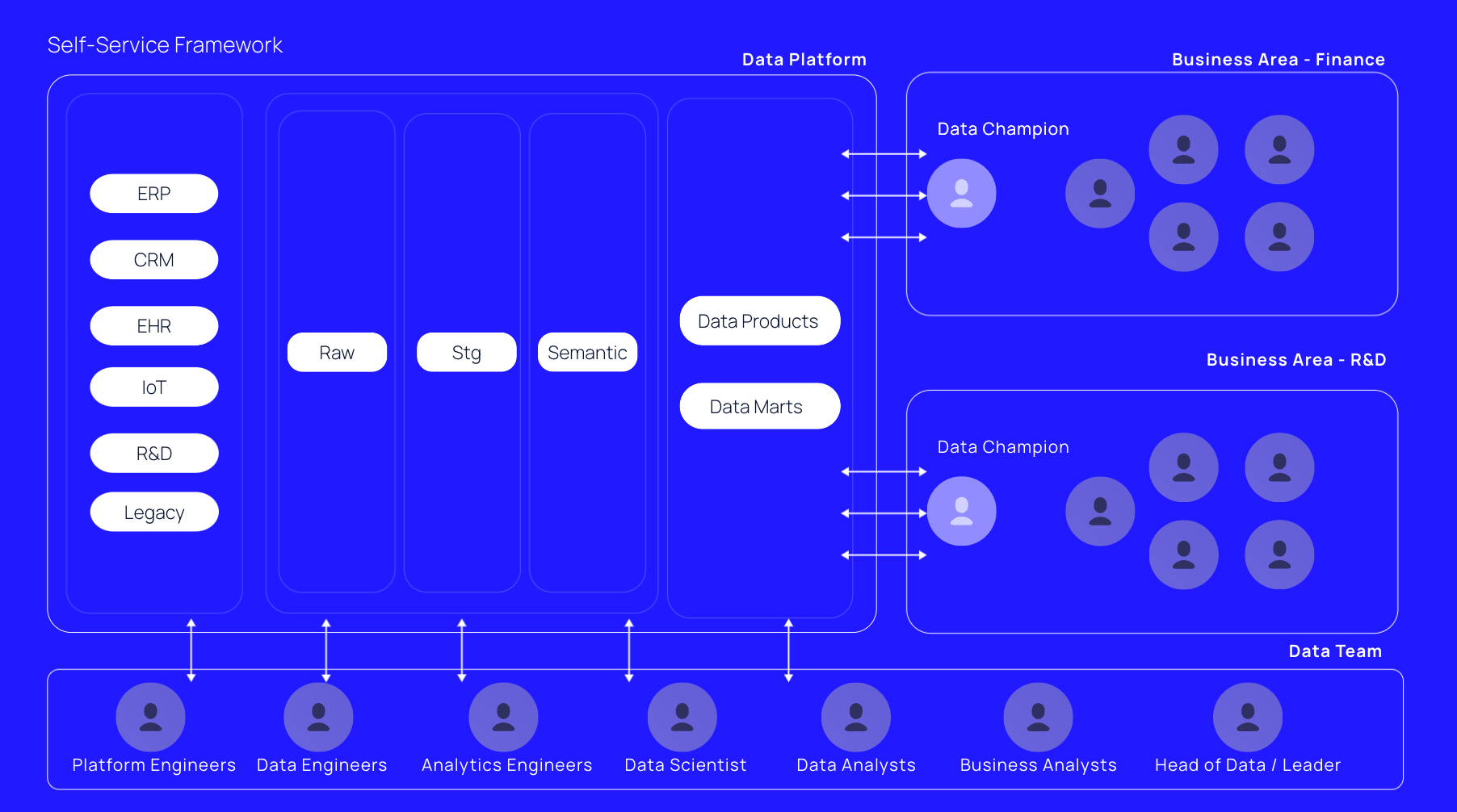
Flexibility is as cultural as it is architectural.
Case in Point: Defense Autonomy as a Data Lesson
When BAE Systems deployed autonomous vehicles in live environments, their data platform had to process:
Telemetry from sensors
Geospatial data from satellites
Cyber signals
Operational directives
all in real time.
They didn’t solve that with a bigger database.
They solved it with architecture designed for agility, standardized ingestion, automated validation, and flexible compute scaling.
That same model is exactly what every enterprise needs to:
React to market shifts faster
Integrate new tools without rewriting pipelines
Deploy AI/ML use cases safely
Scale analytics without rework
Blunt Bottom Line
Stop treating data platforms like plumbing fixed over-engineered systems.
Treat them like the backbone of operational agility.
Data infrastructure should be scalable and adapt to your business.
Not other way around.
Bonus For You
Diagnose your team, identify quick wins, and deliver visible ROI in your first 3 months.
→ Download Data Architecture Playbook: On How To Build For Impact & Agility
We build data foundations, teams your business actually uses to make faster, smarter, profitable decisions, and unlock ai readiness.
📩 Reply to this email or book a strategy session to see how we can do the same for your team to gain trust, clarity and ROI from your data.
Hey, great read as always. This really articulates the practical implications of technical debt, much like your previous pieces on sustainable system design. It underscores a crucial lesson that fundamental principles of agility and robustness are often rediscovered under pressure, far from the allure of new platfoms.